
Last updated August 25, 2026
Free on-site gate assessment - hinges, posts, and your LiftMaster or Nice gate operator checked before anything is quoted
The assessment is free and the quote is the invoice.
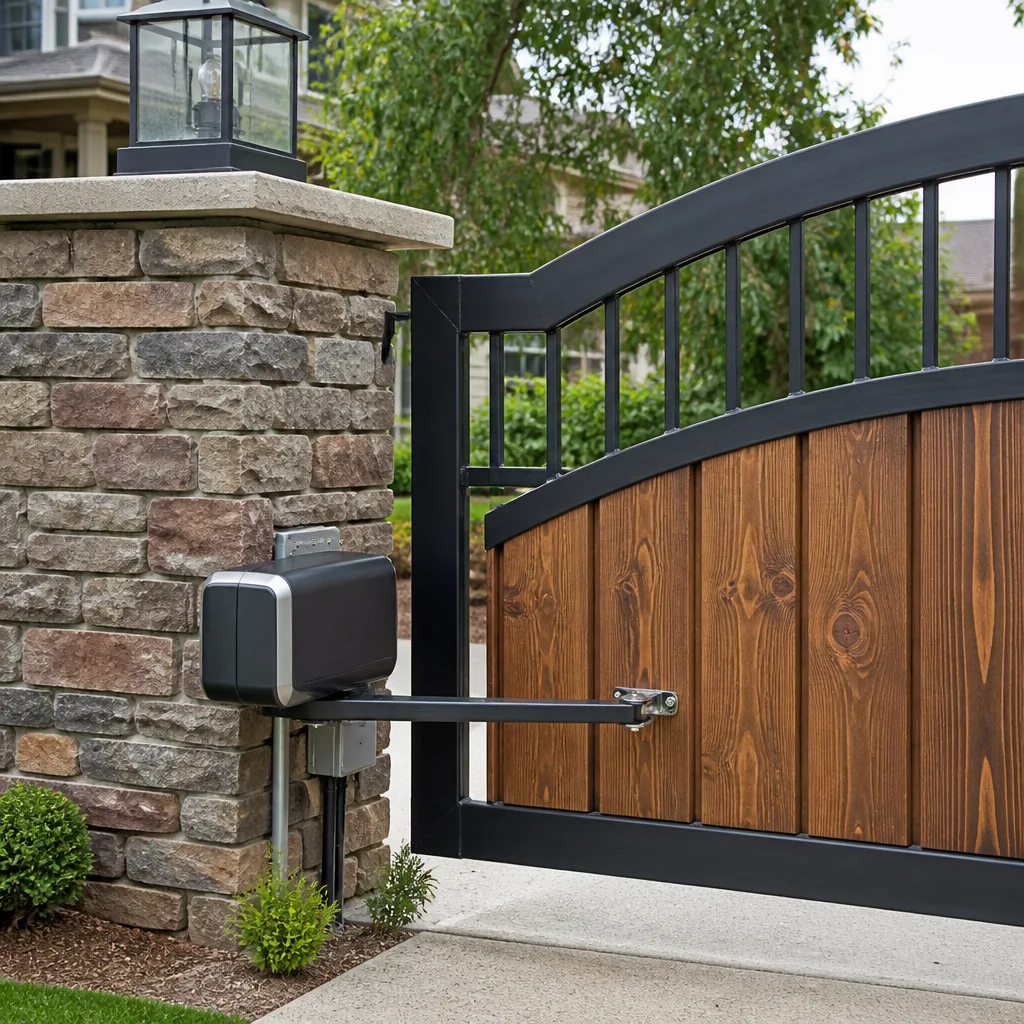
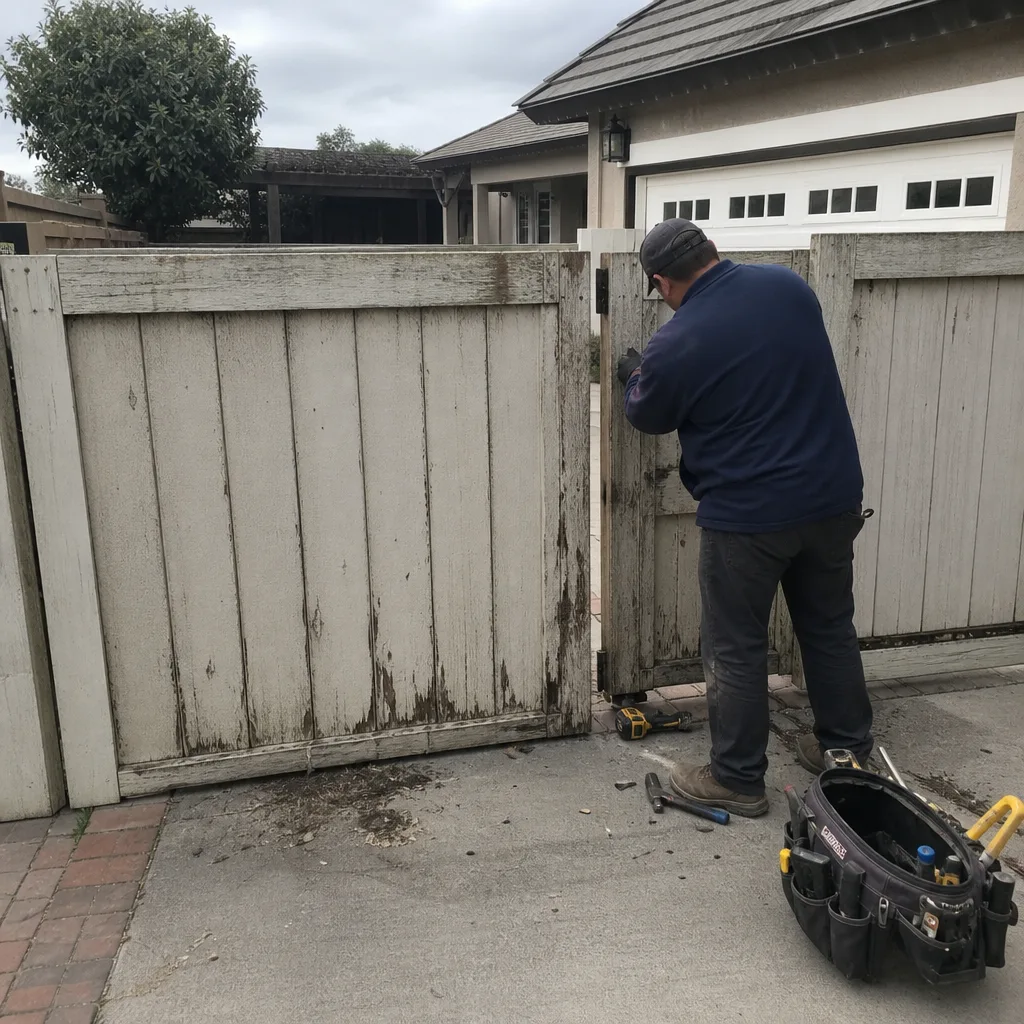 Before
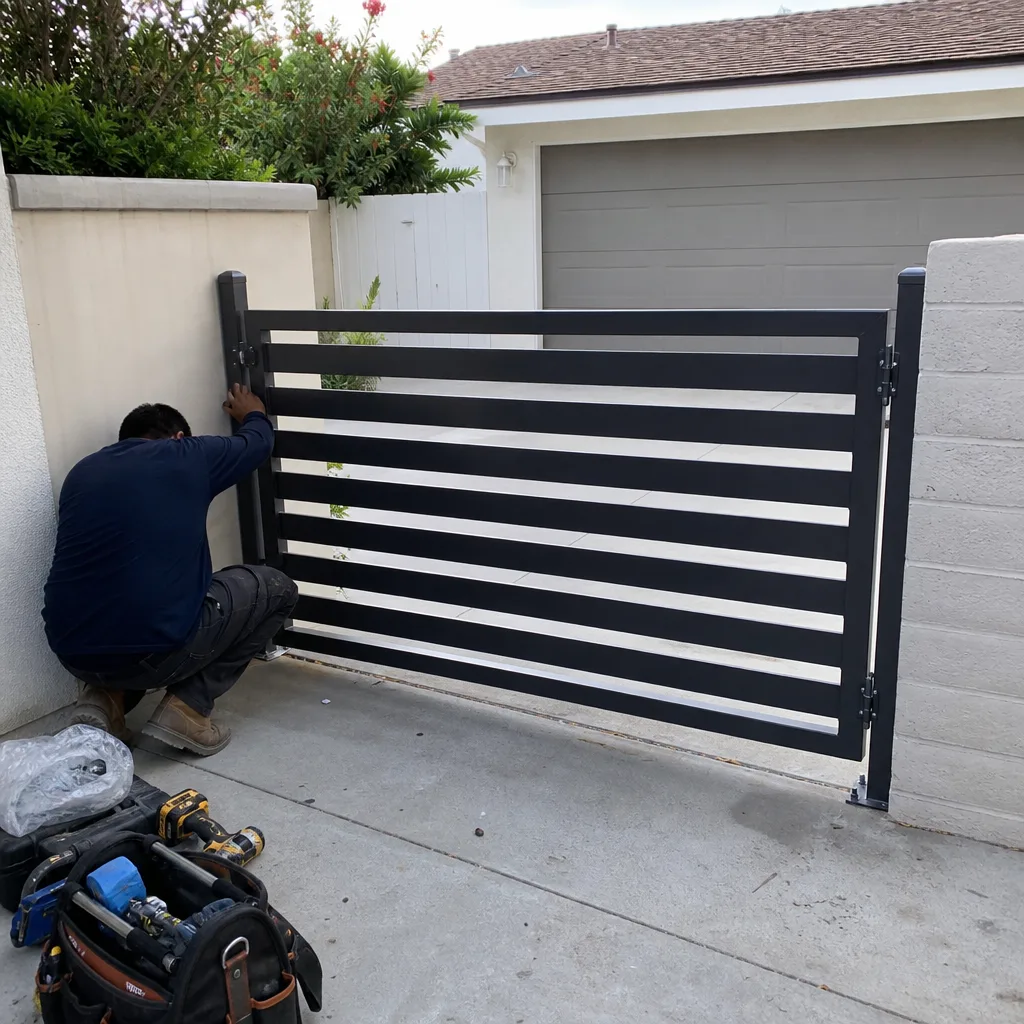 After
After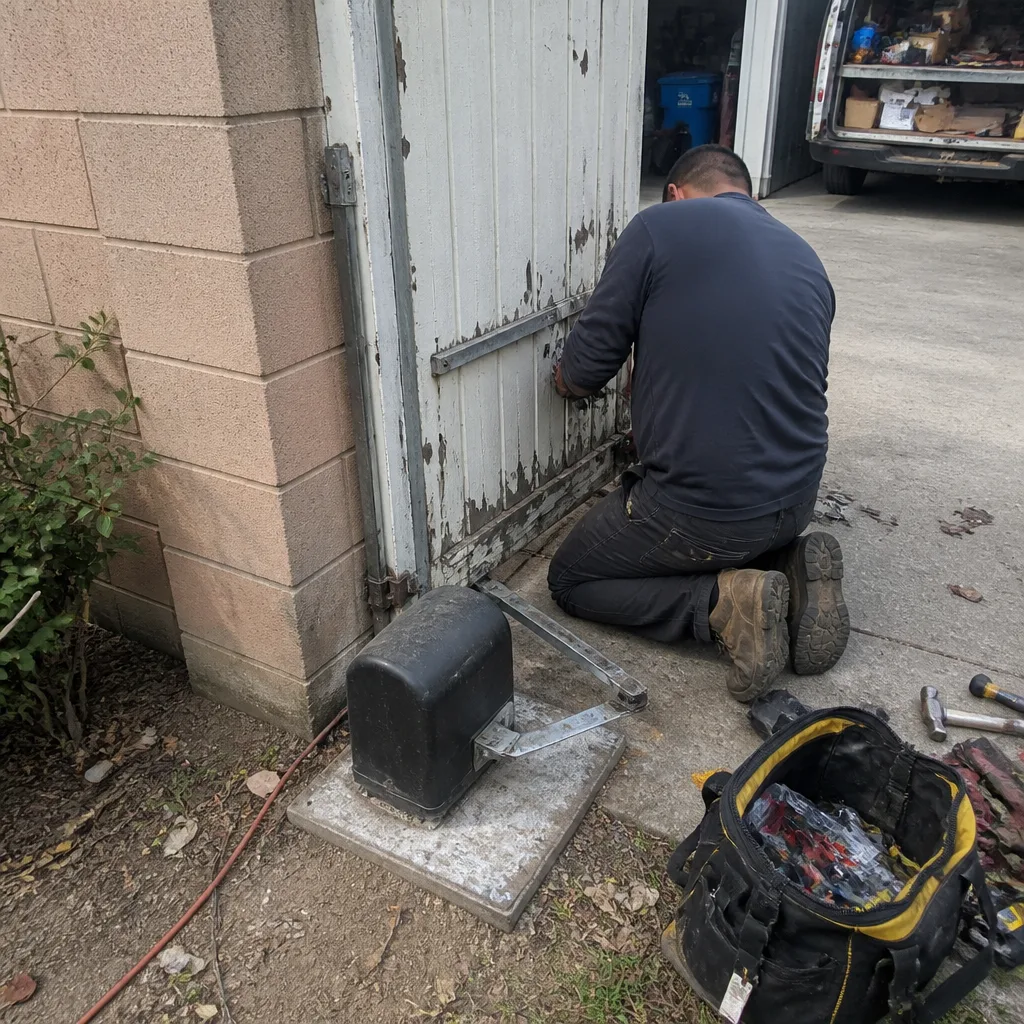 Before
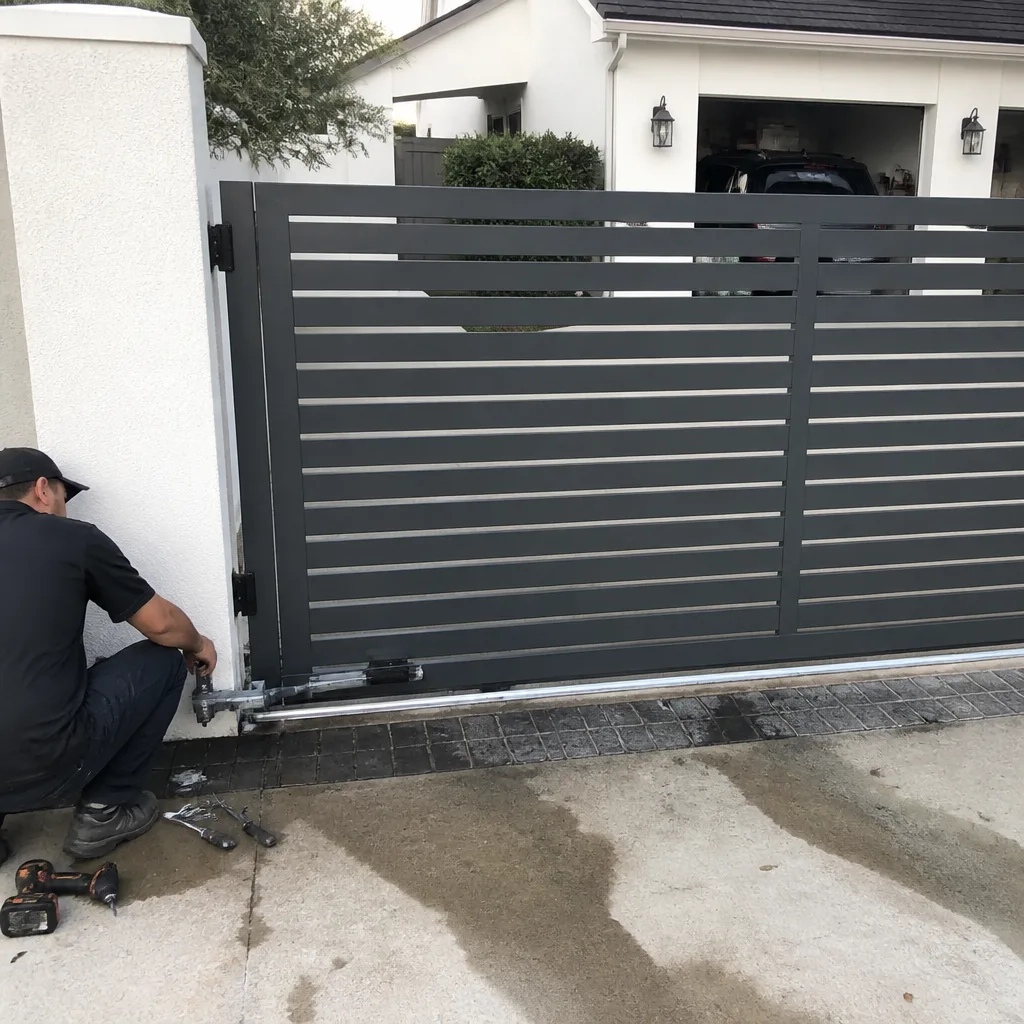 After
After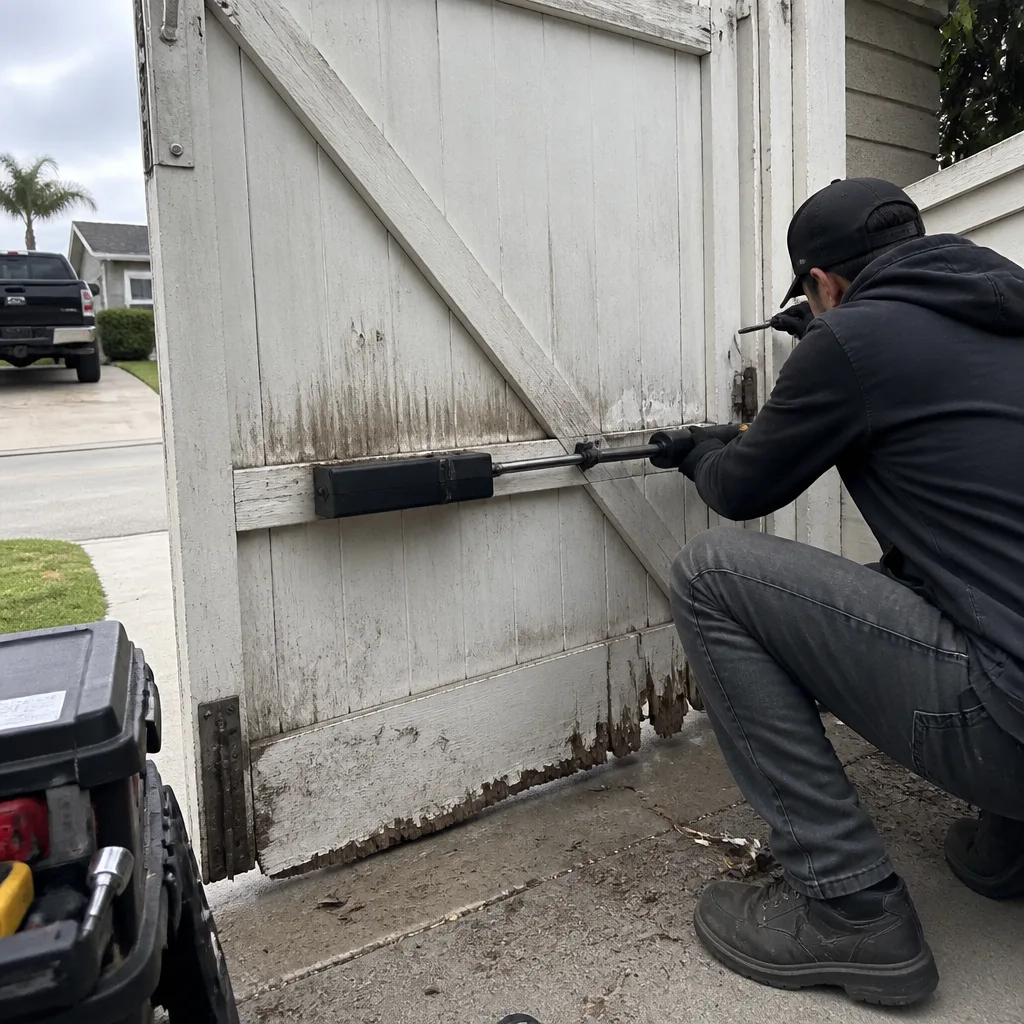 Before
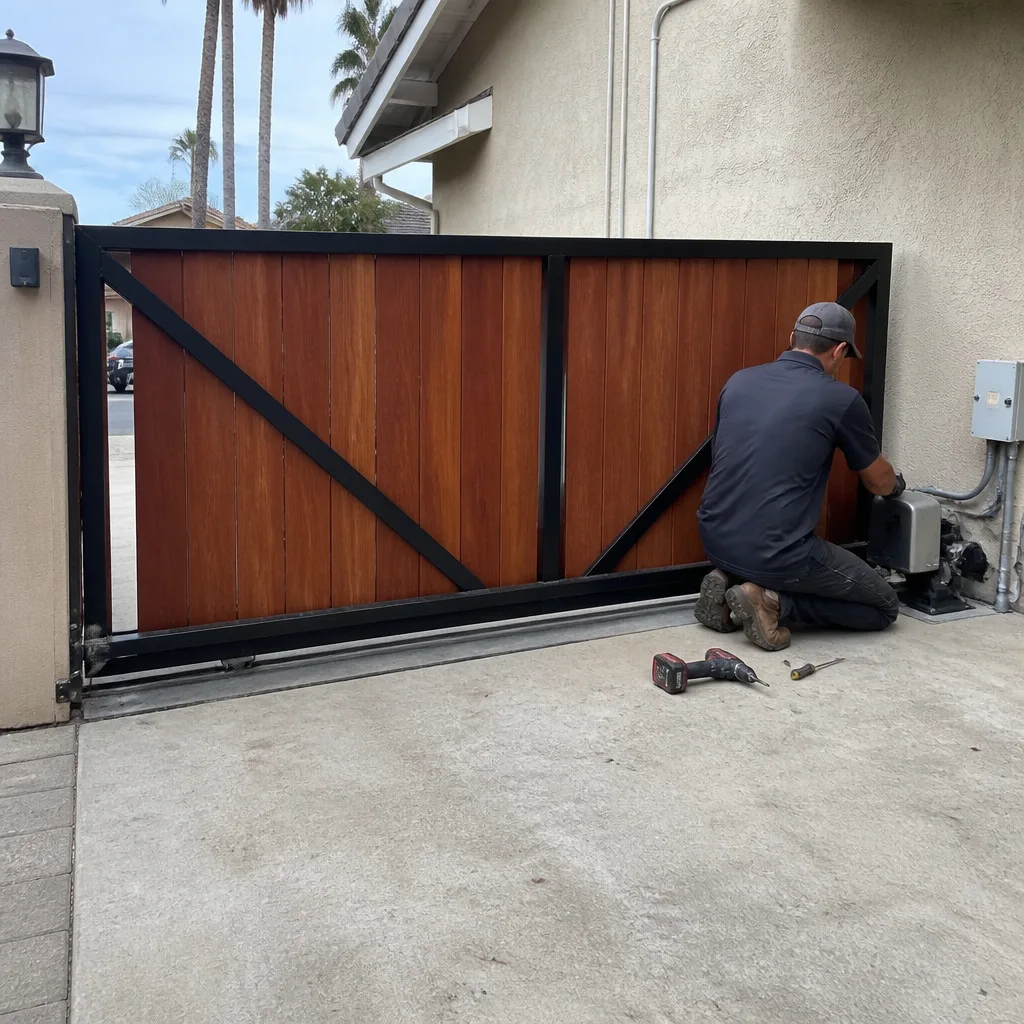 After
AfterSeasonal Gate Repair Care for Huntington Beach: Year-Round Homeowner’s Guide
Most Huntington Beach homeowners don’t think about their gate until it stops moving. By then, the damage is usually done: a corroded hinge that finally seized, a motor that burned out pushing against a misaligned track, a battery that died quietly during a marine-layer stretch in June. The counterintuitive part? Salt air is the real killer, not use. The same ocean breeze that makes Huntington Beach pleasant also delivers a fine, persistent salt mist that works on gate metal twelve months a year. This guide walks through what that means season by season, what to check, what to fix now, and what can wait. It’s written for the homeowner who’d rather spend one afternoon preventing a problem than a week waiting on a repair.
Quick Answer
Seasonal gate care in Huntington Beach means fighting salt corrosion, not snow or ice. A homeowner should inspect hinges, wheels, and the opener battery once per season, wash salt residue off metal and track three or four times a year, and apply a quality lubricant to moving parts in spring and fall. An $89 Seasonal Tune-Up in early spring and again in early fall is the most reliable way to keep a gate running like it should in this coastal climate.
Table of Contents
- Spring Gate Care: Getting Ahead of the Salt
- Summer Gate Care: Heat, Battery Strain, and Vacation Mode
- Fall Gate Care: The Pre-Winter Inspection
- Winter Gate Care: Marine Layer, Moisture, and Motor Health
- The Coastal Corrosion Problem: Why Huntington Beach Gates Age Faster
- Opener Battery Care: The Most Overlooked Part
- What an $89 Seasonal Tune-Up Actually Includes
- Common Mistakes to Avoid
- When to Call a Professional
- Frequently Asked Questions
- The Bottom Line
Spring Gate Care: Getting Ahead of the Salt
Spring is when most Huntington Beach residents notice their gate looks tired. The winter marine layer has been depositing salt and moisture on the metal for months, and now the sun is drying it into a crust that accelerates rust. The first thing we do in early spring is a visual pass: look for rust blooms at the hinge pins, at any weld joints, and along the bottom rail where the gate meets the concrete. A little surface rust is normal on an older gate. Deep pitting or flaking is a sign it’s time to act.
A thorough spring maintenance sequence looks like this:
- Wash the gate and track. Use a garden hose with a spray nozzle and a mild dish soap. Avoid a pressure washer on the opener, the keypad, or the photo eyes - high pressure forces water past seals and into the motor housing. A gentle rinse is enough.
- Inspect the hinge pins and wheels. Look for rust, wobble, or a sagging gate leaf. A gate that scrapes the driveway is telling you the hinge bearings are worn. In Huntington Beach, sea air turns a ten-year-old bearing set into a fifteen-year-old bearing set faster than inland homes would see.
- Lubricate moving parts with a dry-film or marine-grade lubricant. Not WD-40. WD-40 is a solvent and water displacer, not a lasting lubricant. We use a lithium-based or PTFE lubricant on hinge pins, wheels, and the chain or belt drive. Avoid spraying the track itself - a slippery track reduces the opener’s ability to hold the gate in position.
- Check the opener battery. If your gate runs on a battery backup system (most do in Huntington Beach, where power flickers are routine in summer), spring is when you replace it if it’s older than three years. A weak battery doesn’t warn you; it just dies the first time the power goes out.
- Run the gate through three full open-close cycles. Listen for grinding, hesitation, or a change in speed. A gate that slows down or stutters at the same point every cycle is telling you something specific - usually a track obstruction or a failing capacitor in the opener.
In neighborhoods like South Huntington Beach and off Edwards Street, we see the same spring pattern every year: gates that sat mostly closed through the mild winter, then get used heavily as the weather warms, and fail at the hinge or the opener limit switch. A little attention in March prevents most of it.
Summer Gate Care: Heat, Battery Strain, and Vacation Mode
Summer in Huntington Beach is the season of constant gate use. Kids are home, deliveries double, the barbecue invites mean visitors cycling the gate open and closed more in a weekend than it moved all of February. That’s good - a gate that moves regularly tends to stay in better mechanical shape than one that sits. But summer brings two specific problems: heat on the opener components and heavier electrical load on the motor.
Direct sun on a metal gate panel in July can take the surface temperature past 140 degrees, even in a coastal climate like Huntington Beach. Your opener is mounted behind or beside that panel, and that heat radiates into the motor and control board. Components age faster in heat, particularly capacitors and relays. If your gate is exposed to afternoon sun with no shade, consider a simple shade panel or planting a low hedge a few feet back from the gate - not against it, because foliage traps moisture and makes corrosion worse.
Summer is also when the salt fog is less visible but no less corrosive. The onshore breeze carries minuscule salt particles that settle on everything. A quick rinse in June, another in August, is the cheapest gate insurance you’ll buy all year. Ten minutes, a hose, done.
If you leave for a vacation, set the gate in its manual or “hold open” position only if your home security allows it. Better: leave it in automatic mode and ask a neighbor to cycle it once mid-week. A gate that sits unmoving for two weeks in salt air is a gate that will stick when you return. If you have a Ghost Controls or Linear opener with a battery backup, unplugging and reconnecting the unit before you leave resets the system and clears any stored error codes that might trip while you’re away.
One more summer note: the sand. Huntington Beach driveways collect it. Sand works its way into the track, into the wheel bearings, and into the hinge pins. It acts as a grinding paste. Sweep the driveway and track weekly during beach season and rinse the gate every two weeks. Your hinges will thank you.
Fall Gate Care: The Pre-Winter Inspection
Fall in Huntington Beach doesn’t look like fall anywhere else. The days stay warm, the nights cool down, and the marine layer returns right around late September. That temperature swing is the quiet signal that the gate needs its pre-winter going-over. Moisture condenses on cool metal overnight and the salt in the air turns it into a corrosive film. This is the single most important maintenance window of the year.
The fall inspection is more thorough than the spring wash. It’s where you catch the small things that become big failures in winter:
- Battery test. Remove and bench-test or simply replace the backup battery if it’s nearing three years old. Winter power outages in Huntington Beach are usually short but frequent, and a gate that won’t open on battery power during an outage is both an inconvenience and a potential emergency access issue.
- Track alignment. Watch the gate move through a full cycle and check that the gap between the gate and the track is consistent from start to finish. Coastal soil shifts slightly with seasonal moisture changes, and a concrete driveway slab that’s moved a quarter-inch can make a gate scrape or bind.
- Weld and hinge inspection. Look at every weld joint with a flashlight. Hairline cracks in welds on older iron gates are common in Huntington Beach because the salt accelerates the rust that hides inside the joint. A crack you can see now is a $150 repair. A cracked hinge that separates is a gate on the ground.
- Keypad and photo-eye check. Test the keypad from the street side, test the photo eyes by blocking the beam and confirming the gate stops or reverses. Wipe the keypad face with a damp cloth - salt buildup shorts out keypad contacts faster than you’d believe possible.
Fall is also when we recommend the $89 Seasonal Tune-Up at Ironworks Gate Co. It’s less than the cost of most single repairs and it catches problems while they’re cheap to address. Victor Salinas has always said the same thing when asked about the tune-up: the best repair is the one you never needed because the tune-up caught it first.
Winter Gate Care: Marine Layer, Moisture, and Motor Health
Huntington Beach winters are mild by any standard, but they’re hard on gates in a specific way. The marine layer sits low and thick from November through February, sometimes lingering all day. Relative humidity at the coastline stays high even when it’s not raining. That means your gate is damp for months at a time. Damp plus salt equals corrosion. Corrosion equals friction. Friction equals a motor working harder than it should, which shortens the opener’s life by years.
The winter protocol is simple and consistent:
- Rinse the gate every four to six weeks. A plain water rinse removes salt buildup before it can start etching into the metal. Do it in the morning after a humid night. Don’t worry about drying it by hand; the sun will do that by mid-morning.
- Keep the track clean. Winter brings leaf debris from neighbors’ trees, even in a coastal city like Huntington Beach where the trees are more likely to be palm and eucalyptus than oak or maple. Palm fronds and eucalyptus bark are surprisingly abrasive in a gate track.
- Watch for condensation inside the opener housing. If your opener’s plastic cover shows water droplets on the inside, the housing seal needs attention. A little moisture inside the box is normal in coastal Huntington Beach; standing water or visible corrosion on the terminals is not.
- Run the gate daily. Even a single open-close cycle per day keeps the bearings moving, distributes lubricant, and prevents the “stuck closed” morning when the gate has adhered slightly to its stops after a damp night.
Winter in Huntington Beach is also when we see the most limit-switch failures. The limit switch is the component that tells the opener “you’ve reached closed, stop pushing.” Salt corrosion on the switch contacts causes erratic behavior: the gate stops short, or reverses for no reason, or slams into the stop harder than it should. If your gate starts doing anything unpredictable, the limit switch is usually the first thing we check.
The Coastal Corrosion Problem: Why Huntington Beach Gates Age Faster
Here’s a fact every coastal homeowner eventually learns: the same gate that would last 25 years in Fountain Valley might last 12 to 15 years in Huntington Beach if it’s not maintained. The salt air that makes this city such a pleasant place to live is chemically hostile to metal. Sodium chloride in the air dissolves into the moisture film that forms on cool metal surfaces and creates a mild acid solution that etches steel, iron, and even aluminum over time. A study by the American Galvanizers Association puts the corrosion rate of zinc-coated steel in a marine environment at four to five times the rate of the same material in a dry inland setting.
What that means practically is the maintenance schedule matters more than the gate’s original quality. A poorly maintained, expensive ornamental iron gate will fail faster than a properly maintained, mid-priced steel gate. The maintenance is the variable.
In Huntington Beach, the closer you are to the water, the worse the problem gets. Homes within a half-mile of Pacific Coast Highway face the heaviest salt load, particularly on the ocean side of the street where the onshore breeze delivers directly. Homes east of Newland Street face measurably less, though still more than inland cities. If you live in the numbered streets just off the ocean, budget for twice-yearly lubrication, not the once-yearly that inland gates tolerate.
The good news is that the countermeasures are well understood. Marine-grade stainless steel hinges and hardware hold up dramatically better than standard galvanized steel. Powder-coating over a proper zinc primer outperforms standard paint. And a consistent maintenance routine, the kind this guide describes, slows corrosion to a fraction of its untreated rate. Visit the Ironworks Gate Co. home page to see how we approach coastal gate longevity.
Opener Battery Care: The Most Overlooked Part
If there’s one component that quietly fails on a Huntington Beach gate, it’s the opener’s backup battery. The battery’s job is simple: keep the gate operable when the power goes out. But batteries age, and in a marine environment, their lifespan runs shorter than the manufacturer’s printed spec. A battery rated for five years in a controlled environment might deliver three in a garage a block from the ocean.
Why batteries fail faster here is straightforward. Heat is the primary killer of lead-acid and lithium batteries alike. A garage or an exterior opener housing in Huntington Beach can hit 100 degrees in the summer. Combine that with salt air forcing minor corrosion on the battery terminals, and the battery’s effective capacity drops steadily.
The symptom of a failing backup battery is specific: the gate works fine on house power but won’t move at all during a power outage, or it moves sluggishly and stops halfway. Many homeowners don’t discover the battery is dead until the one moment they need it most, which is usually a power outage on a summer evening when everyone’s trying to get the car in the garage.
Brands like Viking, Linear, and DoorKing all use similar battery chemistry and similar failure modes. Check the battery annually by unplugging the opener from house power and running the gate on battery alone. If it completes a full open-close cycle without slowing down, the battery is healthy. If it strains or stops, that’s a replacement, not a repair. Replacing a backup battery after the old one dies entirely is the most common mistake we see. A battery that dies completely can sometimes damage the opener’s charging circuit.
What an $89 Seasonal Tune-Up Actually Includes
We get asked about the Seasonal Tune-Up a lot, and the question is usually the same: what is it, really? It’s what a thorough, honest gate maintenance visit should be, and it takes about an hour. Here’s the full list of what our technicians do on an $89 Seasonal Tune-Up in Huntington Beach:
- Full mechanical inspection. Hinges, wheels, track, chain, belt, stops, and any weld joints are checked for wear and play. Any component showing early wear gets noted on the service sheet with a recommendation, not a pressure.
- Lubrication. Proper marine-grade lubricant on every moving point. Not a quick spray. Each hinge pin, wheel axle, and drive component gets attention.
- Opener diagnostics. The control board, limit switches, photo eyes, keypad, and remote receiver are all tested. Error codes are read and cleared. Board firmware notes are made.
- Battery health check. The backup battery is tested under load, and its replacement date is recorded. If it’s weak, you’ll know before you need it.
- Safety function test. We verify the auto-reverse on obstruction, the photo-eye kill, and the manual release all work. A gate without working safety functions is a liability you don’t want.
- Track alignment check. The track is cleaned and any debris is removed. Alignment issues are noted with photos.
The point of the tune-up, honestly, is that it’s cheaper than any repair we do. It’s prevention priced below every repair on our list. Schedule it in early spring and again in early fall, and the odds of an expensive failure drop sharply. Call (424) 999-7545 to book the Seasonal Tune-Up. A live person answers, day or night.
Common Mistakes to Avoid
- Using WD-40 as a gate lubricant. It’s a solvent and moisture displacer, not a real lubricant. It will strip away whatever protective film was there and leave the metal drier than before. Use a lithium-based or PTFE lubricant made for machinery.
- Pressure-washing the gate or opener. High-pressure water forces salt and sand past the seals on the motor housing, the keypad, and the photo eyes. It accelerates the exact damage it’s meant to prevent. A regular hose is plenty.
- Neglecting the battery because the gate works fine today. The backup battery’s entire job is to work when the power’s out, which is the definition of a part you can’t test until you need it. Test it once a year, replace every three years in Huntington Beach’s climate.
- Lubricating the track. A slippery track reduces the opener’s ability to hold the gate still, which causes it to drift or slip. The track should be clean and dry. Lubricate the wheels, the hinges, and the drive chain or belt, not the track.
- Ignoring a gate that scrapes or drags. A scraping gate is a hinge problem getting worse every day. Fix it when it first appears and you’re looking at a small repair. Let it go for a year and the motor has been fighting that friction for 3,000 cycles. Then you’re replacing the motor too.
- Skipping the fall tune-up because “the gate’s been fine all year.” The fall tune-up isn’t for the gate you have today. It’s for the gate you’ll have in February, after three months of damp salt air. Every gate is fine until the day it isn’t.
- Painting over rust without treating it first. Paint seals rust in and lets it spread underneath, hidden until the panel is weak enough to fail. Rust needs to be removed or chemically converted before painting. In a coastal environment, this step matters twice as much.
When to Call a Professional
Some gate problems are safe and sensible for a homeowner to address. Others are not. If the gate has come off its track, if a hinge pin has snapped, if the gate has sagged enough to scrape the driveway, or if the opener is grinding, smoking, or sparking, stop and call someone who does this work every day. High-tension components like torsion springs and counterweight systems carry enough stored energy to cause serious injury if they release unexpectedly. Don’t attempt a DIY fix on those. The same applies to any wiring inside the opener housing. Gate openers run on 120-volt or 240-volt house power, and a bad splice in a marine environment is a fire hazard. Ironworks Gate Co. offers free estimates in Huntington Beach - call (424) 999-7545 and Victor Salinas or a member of the team will give you a straight answer and a written price before any work starts.
Frequently Asked Questions
Twice a year, once in early spring and once in early fall, is the right schedule for most Huntington Beach homes. The coastal air is corrosive enough that annual service leaves too much time for rust and wear to develop unnoticed. The $89 Seasonal Tune-Up at Ironworks Gate Co. covers the mechanical, electrical, and safety check in one visit. Call (424) 999-7545 to book.
Gate repair in Huntington Beach typically runs $150 to $600 for most mechanical repairs, while opener replacement runs higher depending on the brand and horsepower needed. A hinge repair is usually under $200, a complete opener swap is generally over $800 depending on the model. Every job at Ironworks Gate Co. is priced before work begins, in writing, with no surprises on the bill. Call (424) 999-7545 for a free estimate.
We prioritize emergency calls for gate failures that leave a home unsecured or a vehicle trapped. A live person answers the phone 24 hours a day at (424) 999-7545, and we’ll let you know honestly whether we can get a technician to your door today. Most jobs are completed in a single visit.
Paint over untreated rust traps moisture and salt against the metal, and the rust spreads underneath the paint film until the panel is weakened. In Huntington Beach’s marine environment, rust needs to be mechanically removed or chemically converted before any primer and paint goes on. Marine-grade primers and powder-coating hold up far better than standard paint on coastal gates.
Our technicians are trained and equipped on nine major gate automation brands: LiftMaster, FAAC, BFT, Linear, Viking, Ghost Controls, DoorKing, Elite, and Mighty Mule. You don’t have to call a different company depending on what’s mounted on your driveway. If it opens a gate, we service it. Call (424) 999-7545 for a straight answer on your specific opener.
Yes, and the math is simple. An $89 Seasonal Tune-Up costs less than almost any single repair we perform. The tune-up catches hinge wear, battery decline, and track misalignment while they’re cheap and quick to fix. A neglected gate that “was working fine” is the source of most of our emergency calls. Call (424) 999-7545 to schedule a tune-up for spring or fall.
The Bottom Line
Seasonal gate care in Huntington Beach is not complicated, but it is non-negotiable if you want your gate to last. Salt air is the adversary, and it works on your gate every single day, whether the gate moves or not. The maintenance schedule that beats it is modest: a rinse and inspection each season, lubrication twice a year, a battery check annually, and a professional tune-up in spring and fall. The cost of that routine is a fraction of the cost of the repairs it prevents. And every job at Ironworks Gate Co. is priced before we start, in writing, and backed by the 90-Day Done Right Promise. Done right, and backed in writing. That’s the whole point. Call (424) 999-7545 for a free estimate, a second opinion, or the $89 Seasonal Tune-Up. We’ll be there when we say.
Written by Victor Salinas, Owner at Ironworks Gate Co., serving Huntington Beach since 2013.